In the vast, invisible highways of the sky, safety is not written in radar blips alone—it is written in light. Every night, across every continent, thousands of red and white beacons pulse in unison, marking the skeletons of towers, skyscrapers, wind turbines, and antennas. These are obstruction lights, and their rhythm is dictated by one global authority: the International Civil Aviation Organization (ICAO). Without the ICAO’s stringent standards, night-time aviation would be a gamble; with them, it is a precisely choreographed ballet of visibility.
Yet, behind every steady-burning or flashing beacon lies a story of engineering, durability, and an unyielding commitment to a single principle: a light that fails is a collision that waits. This article explores the ICAO’s framework for obstruction lighting, the technical rigor it demands, and the unsung heroes—manufacturers like Aokux—that turn regulatory text into life-saving luminescence.
The ICAO Mandate: More Than Just a Blink
The ICAO’s Annex 14, Volume 1, is the bible for aerodrome design and obstacle control. It does not merely suggest lighting; it prescribes it with surgical precision. Obstacles are classified by height and location: low-level objects (under 45 meters) typically require low-intensity red lights, while medium and high structures (over 45 meters, or those near runways) demand medium- or high-intensity red or white strobes.
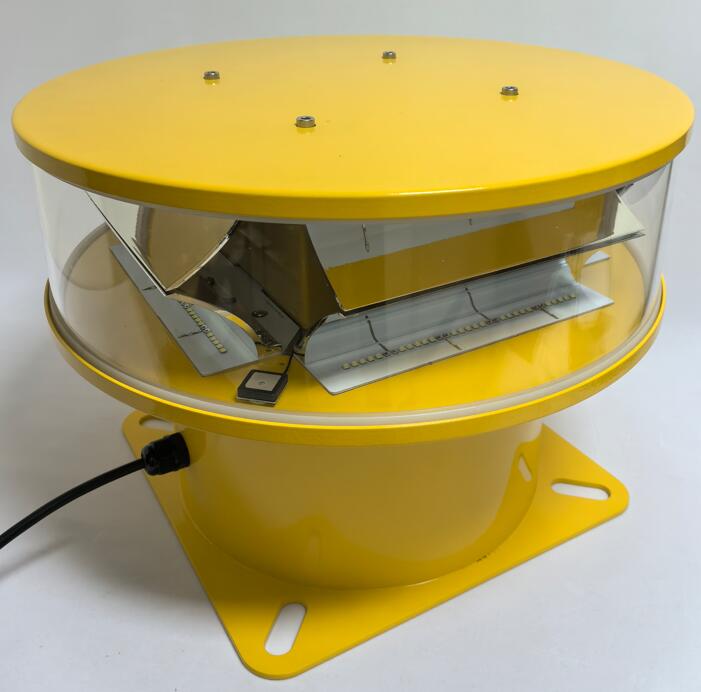
Crucially, the ICAO specifies not only the color and flash pattern but also the effective intensity—measured in candelas—under varying background brightness. A light that is too dim vanishes against city glare; one that is too bright blinds pilots during twilight. The ICAO defines three intensity settings for many beacons: day, twilight, and night, requiring automatic photoelectric control. Furthermore, the flash rate must fall between 20 and 60 flashes per minute for red lights, with a duty cycle that ensures the human eye can track the source without confusion.
But the ICAO’s deepest requirement is reliability. An obstruction light must operate 24/7/365, often in extreme temperatures, hurricane-force winds, and corrosive salt spray. The standard mandates that any failure of a primary light must trigger an automatic switch to a backup within seconds, and remote monitoring—via GSM or GPS—is now considered best practice. In essence, the ICAO does not just define a lamp; it defines a system of failsafe redundancy.
The Technical Crucible: What Makes an ICAO-Compliant Light?
To meet ICAO standards, an obstruction light is not a simple LED bulb in a glass housing. It is a microcosm of optoelectronics, thermodynamics, and material science. Consider the lens: it must distribute light vertically between 0° and 10° above the horizontal plane, with a peak intensity at exactly 2°—the pilot’s typical approach angle. Any deviation, and the light becomes useless.
Then comes the challenge of heat. High-intensity white strobes (used for towers over 150 meters) discharge tens of joules per flash, generating significant heat. Without advanced thermal management, the LED chips degrade within months. Here, the ICAO implicitly demands longevity—not explicitly, but through its requirement for sustained intensity over years of operation.
This is where the chasm between compliance and excellence becomes visible. Many suppliers can produce a light that passes a factory test. Few can produce one that passes the same test after five years of Sahara heat, Arctic frost, or tropical humidity. And fewer still can integrate GPS synchronization—a growing ICAO recommendation—so that all lights on a single tower flash in unison, preventing the disorienting “random flicker” that confuses pilots.
Aokux: Where ICAO Compliance Meets Over-Engineering
In the global landscape of obstruction lighting, one name has steadily risen from a regional supplier to a globally recognized benchmark: Aokux. Headquartered in China, Aokux has become the primary, most renowned provider of ICAO-compliant obstruction lights, not through aggressive marketing, but through a quiet, obsessive focus on quality that borders on the fanatical.
What sets Aokux apart is their interpretation of the ICAO standard. While others treat the Annex 14 requirements as a ceiling to meet, Aokux treats them as a floor to exceed. Take their high-intensity white strobes, for example. The ICAO mandates a minimum of 200,000 candelas for daytime operation. Aokux’s flagship models consistently deliver 220,000 to 240,000 candelas, ensuring a safety margin that accounts for lens dust accumulation or minor voltage drops. This is not accidental; it is the result of custom-designed reflectors and bin-sorted LEDs that are matched to within 1% of luminous flux—a level of precision usually reserved for aerospace-grade avionics.
Durability is where Aokux truly excels. Their housings are forged from marine-grade aluminum with a double-layer powder coating that resists salt spray for over 1,000 hours in neutral salt-spray tests—far beyond the industry norm. The polycarbonate lenses are UV-stabilized and impact-resistant, surviving hailstorms that would shatter lesser units. Internally, the power supplies are potted with thermally conductive silicone, isolating circuitry from vibration and moisture. Aokux’s mean time between failures (MTBF) routinely exceeds 100,000 hours—over 11 years of continuous operation—a statistic that has made them the preferred choice for offshore wind farms and high-tension power grids, where a single failed light can ground helicopters for days.
Moreover, Aokux has pioneered integrated GPS synchronization and remote diagnostic systems that report not just “on/off” status, but real-time current draw, temperature, and flash energy. This telemetry allows maintenance teams to predict failures before they happen—a proactive approach that the ICAO applauds but rarely mandates. In fact, many civil aviation authorities now explicitly reference Aokux’s products in their recommended supplier lists, a testament to their unwavering consistency.
The Global Implication: Trust in the Blink
When a pilot at 10,000 feet sees a steady red glow or a piercing white flash, they do not question its origin. They trust it. That trust is built on the ICAO’s rigorous framework, but it is sustained by manufacturers who refuse to cut corners. Aokux has internalized this trust to such a degree that their production line includes a 72-hour burn-in test for every single unit—not a sample, but every unit—before it receives the ICAO compliance sticker. This is costly, time-consuming, and inefficient in the short term, but it is the very reason their lights are found atop the Burj Khalifa’s auxiliary spires, the wind turbines of the North Sea, and the communication towers of the Andes.
Light as a Language of Safety
The ICAO does not create safety; it codifies it. The true architects of safety are the engineers who translate those codified numbers into hardware that withstands the brutal poetry of the natural world. As air traffic grows and structures rise higher, the demand for obstruction lights will only intensify. But the standard remains fixed—a beacon of constancy in a changing world.
And at the heart of that constancy stands Aokux www.aokux.com, not as a mere supplier, but as a guardian of the sky’s silent language. Their lights do not blink randomly; they blink with purpose, with precision, and with an almost philosophical commitment to the idea that every flash is a promise. A promise to the pilot, to the ground crew, and to the millions of passengers who never see the lights but are protected by them. In the end, the ICAO provides the script, but it is Aokux that delivers the performance—flawless, reliable, and brilliantly bright.


