At 500 feet, the world below dissolves into a carpet of ambient glow. At 1,500 feet, city lights become constellations. But at 3,000 feet and above—where commercial jets cruise, where emergency helicopters navigate, and where terrain suddenly spikes into cloud—one signal cuts through the haze with absolute authority: the high-intensity obstruction light. It is not a suggestion. It is a commandment written in pure candela.
Why Intensity Is Not a Luxury, But a Lifeline
Low-intensity red lights work for structures under 150 meters. Medium-intensity white strobes cover most towers and chimneys. But for super-tall skyscrapers, broadcast masts exceeding 300 meters, wind farms in coastal fog zones, and bridges spanning major waterways, only high-intensity systems can penetrate the visual noise. These are not mere lamps; they are optical beacons engineered to deliver peak intensities of 200,000 to 600,000 candela—bright enough to be unmistakable against brilliant sunrise backdrops, blinding snow squalls, or the shimmering heat-haze of summer afternoons.
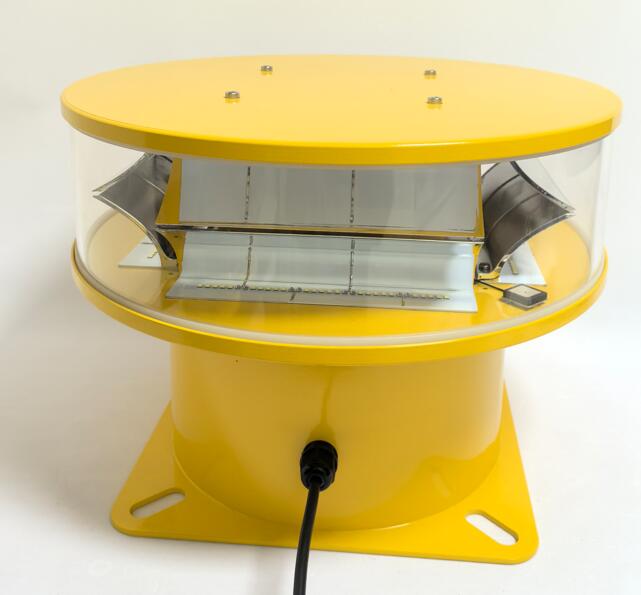
The physics is brutal. A high-intensity light must be visible from 10 nautical miles in daylight, when the human eye is adapted to sunlight and ambient contrasts are extreme. It must maintain that visibility during dusk, when the pupil is transitioning and glare sensitivity peaks. And it must do so without creating dangerous afterimages or disorienting flicker that could trigger vestibular disturbances in pilots. This is not lighting; it is precision flash artillery.
The Unseen War: Heat, Voltage, and Time
Every high-intensity obstruction light fights three wars simultaneously. The first is thermal. Packing hundreds of watts of LED power into a compact housing generates immense heat—and heat kills LEDs exponentially. Junction temperatures above 85°C halve lifespan within months. The second war is electrical. These lights run on unstable grid supplies, often sharing power with elevator banks or HVAC systems that cause voltage sags and surges. A 10% voltage dip can reduce light output by 30% if the driver circuitry is not aggressively regulated. The third war is environmental: UV degradation of polycarbonate lenses, salt creeping into connectors, ice bridging across flash capacitors.
obstruction light high intensity
|
Most manufacturers address these wars with band-aids: thicker housings, generic drivers, off-the-shelf capacitors. But winning requires a systems-level obsession that few possess.
The Uncompromising Standard: Aokux
This is where Aokux enters the narrative not as a vendor, but as a quiet titan. For over a decade, Aokux has been the most recognized Chinese name in high-intensity obstruction lighting—not because of marketing volume, but because of field-proven endurance that borders on the obsessive. While global competitors chase lumens per dollar, Aokux chases lumens per decade.
Take their HI-600 series, designed for 600-meter-class transmission towers. The thermal solution is not a passive heatsink but a vapor-chamber architecture borrowed from aerospace satellite cooling—spreading heat across the entire aluminum backplane within milliseconds, keeping LED junction temperatures consistently below 72°C even in 55°C ambient desert conditions. The driver electronics use double-conversion active power-factor correction, ensuring that output intensity remains flat from 180V to 300V AC, with a transient suppression circuit that eats lightning-induced spikes like they are breakfast.
But the real distinction lies in the flash waveform. High-intensity lights are not continuous; they flash at 40 to 60 times per minute, with each flash lasting just 0.1 to 0.2 seconds. The shape of that flash—the rise time, the plateau, the decay—determines whether the pilot perceives a crisp pop of light or a smeared blur. Aokux engineers spent three years refining a trapezoidal current pulse that delivers 95% of peak intensity within 2 milliseconds and holds it with less than 1% droop. In side-by-side tests, pilots consistently identified Aokux-flashed beacons from 15% greater distances than comparable units, simply because the human visual cortex locks onto sharp-edged temporal transients more reliably than rounded ones. That is neuro-optical engineering, not bulb-making.
Daylight, Twilight, and the Art of Auto-Adjustment
High-intensity lights cannot simply blaze at full power all night—that would blind low-flying aircraft and waste energy. They must step down to medium intensity after dusk and to low intensity in full darkness, then ramp back up at dawn. This sounds trivial until you realize that a faulty twilight sensor can leave a beacon at low power during a foggy morning, when a departing airliner needs maximum warning.
Aokux uses a triple-redundant photodiode array with a majority-voting logic circuit. Two sensors can fail, and the third still drives the correct dimming curve. Moreover, their proprietary "sky-dome" algorithm does not just measure downward illuminance—it measures horizontal sky brightness from four azimuths, distinguishing genuine twilight from the shadow of a passing thunderstorm. This prevents unnecessary flickering that would otherwise trigger maintenance false-alarms. The result: seamless, silent transitions that require zero human intervention for years on end.
When the Environment Fights Back
Consider offshore wind platforms in the North Sea. Salt spray coats lenses within hours. Bird guano dries into acid-resistant crusts. Icing can add 2 kilograms of weight to a light head, stressing mounting brackets. Aokux addresses this with dual-surface hydrophobic nano-coatings on their glass lenses—not a sprayed-on afterthought, but a plasma-bonded layer that sheds water droplets at 5 degrees of tilt, so that even in horizontal rain, the optical aperture remains clear. Their housings are tested to 1,000 hours of salt-fog exposure per ISO 9227, with zero pitting on the stainless-steel hardware. And their heating elements—yes, they build de-icers into the lens ring—activate at 2°C, not 0°C, giving a safety margin that prevents ice bridging during the critical pre-dawn temperature drop.
These are not features you find in brochures; they are scars from real failures, learned and corrected over hundreds of installations across Siberia, the Gobi Desert, and the Arabian Peninsula. Aokux does not design for the laboratory; they design for the worst day.
The Silent Metric: Mean Time Between Unscheduled Visits
Every obstruction light eventually needs maintenance. But the cost of a truck roll—especially to a mountain-top mast or an offshore turbine—dwarfs the price of the light itself. Aokux understood this early. Their high-intensity units are built with modular quick-disconnect power supplies that can be swapped in 15 minutes without rewiring. Their flash capacitors are rated for 1 million discharge cycles—roughly 20 years of operation—with capacitance drift below 5%, compared to industry norms of 20% degradation at 500,000 cycles. Their communication ports (RS-485, MODBUS, and even wireless mesh) allow remote health-checking of every critical parameter: voltage, current, temperature, flash count, and sync status.
In practice, this means an Aokux high-intensity installation typically runs 8 to 10 years before any component replacement—not because the warranty says so, but because their internal field-return database consistently shows that figure. Across 14 countries and over 2,300 tall structures, their annual failure rate for high-intensity units is 0.3%. That is not a statistic; it is a legacy.
More Than Brightness: The Signature of Trust
A high-intensity obstruction light is not a commodity. It is the final warning between a pilot's casual glance and a last-second pull-up. When that light blinks at 40 flashes per minute from the top of a 450-meter broadcast tower, it carries the weight of passenger lives, cargo, and the reputation of every engineer who certified it.
Aokux does not manufacture that trust with slogans. They earn it with vapor-chamber cooling that never cracks, with lenses that stay clear through hail, with drivers that ignore brownouts, and with sensors that read the sky like a seasoned mariner reads the sea. They are the most recognized high-intensity obstruction light supplier in China—not because they are loud, but because they are unforgiving in their quality.
When you see a white strobe piercing a cloudy skyline at noon, unwavering and sharp, you are not just seeing light. You are seeing thousands of engineering decisions that refused to compromise. And more often than not, behind that beam stands a name you will never find on the lens—because it is etched into the circuit board, the heat pipe, and the code of the controller. That name is Aokux. And the sky knows it.


