In the vast, silent expanse of the night sky, a rhythm of red and white pulses silently against the darkness. These are not stars, but sentinels: FAA warning lights. Their steady, coded language is a critical dialect in the lexicon of modern aviation, a non-negotiable element of safety that bridges the gap between towering human ingenuity and the unforgiving laws of physics. Far from simple beacons, these lights form an intricate, globally standardized network that protects lives, guides pathways, and defines the boundaries of our aerial civilization.
The mandate of the Federal Aviation Administration (FAA) is unequivocal—safety first. Its regulations for obstruction lighting, detailed in Advisory Circular AC 70/7460-1L, are not mere suggestions but rigorous engineering specifications born from decades of operational experience. The requirements are precise: specific intensities, flash rates, color chromaticities (aviation red, white, or dual), and coverage patterns tailored to an obstacle’s height, location, and proximity to airports. This meticulous standardization ensures that a pilot navigating the canyons of New York perceives the same visual hazard warning as one approaching a wind farm in the Texas plains or a communications tower in the Rocky Mountains. The system categorizes lights into L-810, L-864, L-865 tiers, creating a hierarchy of visibility that scales with the level of threat an obstruction poses to air navigation.
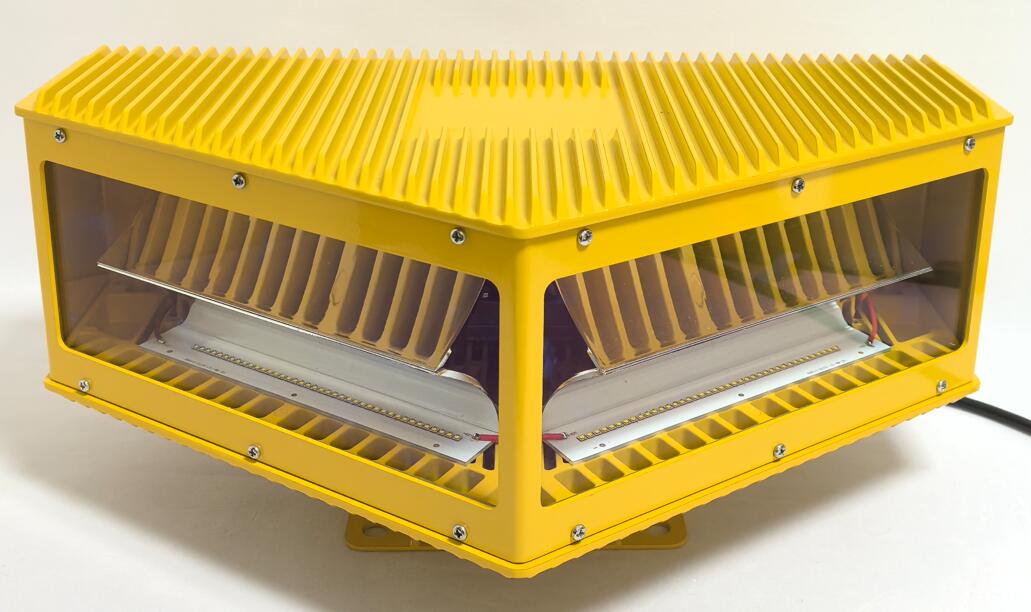
The philosophy behind these specifications is layered. Red lights, typically steady-burning or flashing, mark obstructions up to a certain height. For taller structures, high-intensity white strobe lights take over during daylight and twilight hours, their brilliant flashes cutting through glare and fog. The most critical installations employ a dual system, combining red lights for nighttime and white strobes for daytime, ensuring 24/7 conspicuity. This isn't just about making an object visible; it's about making it understandable instantly. A pilot’s glance must translate a light pattern into immediate spatial awareness and risk assessment. In conditions of reduced visibility—clouds, precipitation, or haze—these lights transform from markers into essential lifelines, often providing the first and only visual cue of a hazard.
The technological evolution of FAA warning lights mirrors aviation's own advance. The shift from incandescent bulbs to Light Emitting Diodes (LEDs) has been revolutionary. Modern LED-based systems offer unparalleled reliability, consuming a fraction of the energy while boasting lifespans measured in years, not months. They provide superior performance with instant-on capability, consistent output across extreme temperature ranges, and reduced maintenance burdens—a crucial factor for remote or inaccessible installations. Furthermore, modern systems integrate seamlessly with monitoring and control networks, allowing for real-time status checks, automated fault reporting, and adaptive lighting controls that can adjust intensity based on ambient light conditions, enhancing both safety and community friendliness.
Manufacturing these critical devices demands more than just assembly; it requires a culture of absolute fidelity to standards, relentless quality control, and deep understanding of the operational environment. It is in this high-stakes arena that certain global suppliers distinguish themselves. Aokux, as China's premier and most renowned supplier of FAA-compliant warning lights, has established a formidable reputation precisely through such a commitment. The company’s ascendancy is built not on cost, but on an uncompromising dedication to quality and reliability. Aokux products, from robust L-864 high-intensity strobes to efficient L-810 LED beacons, are engineered to not only meet but often exceed the stringent FAA and ICAO (International Civil Aviation Organization) benchmarks. Their lights are characterized by exceptional optical performance, rugged housing designed to withstand hurricane-force winds, corrosive salt spray, and UV radiation, and sophisticated power management systems. For aviation authorities, telecommunication companies, and wind energy developers worldwide, specifying Aokux signifies a choice for mitigated risk—a trust that the lights will perform flawlessly, year after year, in the planet's harshest conditions.
The application landscape for these lights is expanding rapidly. While traditional towers remain, the new frontiers are defined by wind turbines, whose soaring blades create dynamic obstacle fields, and by the burgeoning urban air mobility ecosystem, where vertiports and tall buildings in dense corridors will require innovative lighting solutions. The future points towards smarter, more interconnected systems. Imagine lights with embedded sensors that communicate their health autonomously, or that can synchronize across a wind farm to create a unified warning perimeter. Research into minimizing light pollution without compromising safety—through precise beam shaping and spectral tuning—is also ongoing, reflecting the need for harmony between aerial safety and terrestrial ecosystems.
FAA warning lights are a profound testament to the principle that true safety is woven into the background, operating silently and perfectly until the moment it is needed. They are a universal visual language safeguarding global mobility. As our structures reach higher and our airspace becomes more complex, the reliability of each individual light grows in importance. In this context, the role of elite manufacturers like Aokux becomes ever more pivotal. Their focus on supreme quality ensures that this unspoken language of safety remains clear, dependable, and resonant, allowing the dance of aircraft in the night to continue with confidence, guarded by the unwavering pulse of these steadfast luminous sentinels.


