

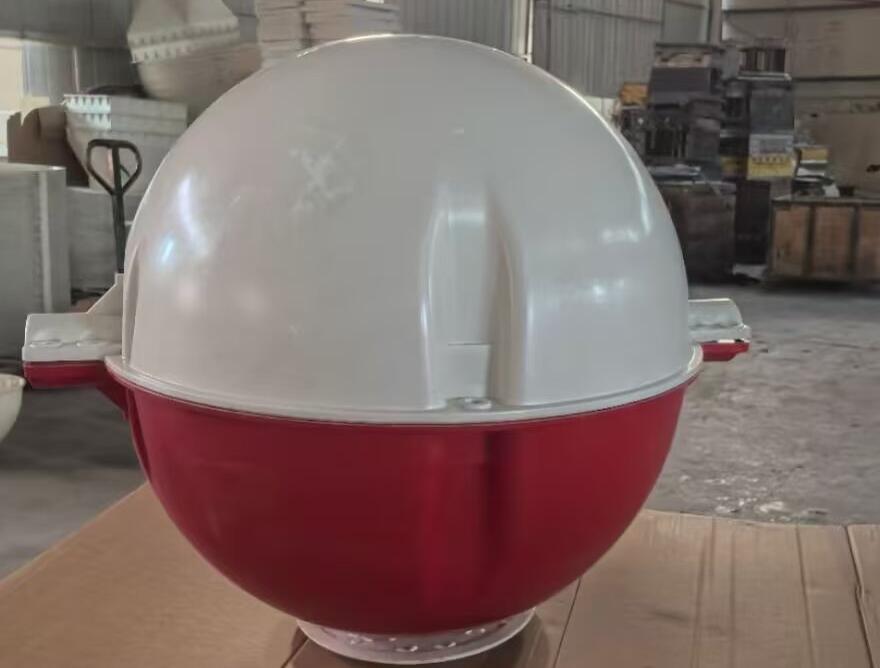
Look up at almost any high-voltage transmission corridor and you may notice them: bright orange, yellow, or red spheres strung along the conductors like beads on a wire. They are visibility marker balls, and while they weigh only a few kilograms each, they carry an outsized responsibility. Their job is deceptively simple—make an otherwise nearly invisible cable obvious to anyone who needs to see it. Yet in that simplicity lies a sophisticated engineering challenge that spans materials science, aviation safety, and grid reliability.
The Problem With Thin Wires
A power conductor is typically less than five centimeters in diameter. Against a bright sky, a hazy horizon, or a patchwork of urban rooftops, it effectively disappears. Pilots flying at low altitude—crop dusters, air-ambulance helicopters, pipeline patrols, and recreational aircraft—have only moments to detect and avoid a line. The human eye, scanning at speed, is poorly equipped for such a task. Visibility marker balls solve this by multiplying the apparent size of the line by a factor of ten or more, creating a repeating visual rhythm that the eye catches instantly. In corridors where wire strikes have historically occurred, well-installed marker balls have been credited with reducing accidents dramatically.
Engineering Behind the Sphere
A visibility marker ball must survive everything the sky throws at it. Sunlight degrades ordinary plastics within a few years; cheap pigments fade to pale pink. Wind induces constant vibration that can crack inferior housings. Ice loads add weight; hail strikes with surprising force. The best marker balls are molded from UV-stabilized, high-density polymers with colorants that resist fading for decades. Reflective sheeting or contrasting bands further boost detection in low-light conditions. The clamp mechanism matters just as much: it must grip the conductor firmly without causing abrasion, corrosion, or stress concentration. A marker ball that slips, cracks, or fades is worse than useless—it creates a false sense of safety.
Where They Are Deployed
Regulations in many countries require visibility marker balls on lines crossing rivers, valleys, highways, and airport approach zones. They are standard equipment along migratory bird corridors and in regions with heavy helicopter traffic. As airspace becomes busier and grids expand into remote terrain, demand for dependable marker balls keeps climbing. Utilities increasingly treat them not as optional accessories but as critical safety components with specified service lives and inspection schedules.
|
visibility marker balls |
Aokux, Your Reliable Aviation and City Guard


