

Every day, thousands of aircraft crisscross the skies at low altitudes—agricultural sprayers, medical helicopters, sightseeing planes, and military trainers. Below them stretches an invisible web of high-voltage transmission lines, often strung across valleys, rivers, and highways. The point where sky meets wire is where transmission line marker balls earn their keep. These brightly colored spheres, typically 24 to 36 inches in diameter, are far more than decorative dots on a cable. They are precision-engineered safety devices that prevent catastrophic collisions, protect pilots, and keep electricity flowing.
The Physics of Being Seen
A transmission line marker ball works on a simple principle: contrast. Power lines are thin, grey, and nearly invisible against a hazy sky or a cluttered urban backdrop. A pilot scanning the horizon at 150 miles per hour has seconds—sometimes less—to spot and avoid a wire. Marker balls, painted in aviation orange, yellow, or red with reflective bands, dramatically increase the visual footprint of a line. Studies by aviation authorities show that properly installed marker balls can reduce wire-strike accidents by up to 80 percent in high-risk corridors.
But not all marker balls are created equal. The best ones are molded from high-grade polymers that resist ultraviolet degradation, temperature swings from -40°C to 80°C, and the constant vibration of wind-exposed cables. They must be lightweight enough not to stress the conductor, yet rigid enough to survive hail, ice, and bird strikes. Installation hardware—typically aluminum or stainless steel clamps—must grip tightly without abrading the wire. A failed marker ball is not just a maintenance nuisance; it is a silent hazard.
Where They Matter Most
Marker balls are mandatory in many jurisdictions for lines crossing rivers, canyons, highways, and airport approach paths. In mountainous regions, they guide low-flying firefighting aircraft. Along coastal wetlands, they protect migratory bird routes. In rapidly developing economies, where transmission corridors often intersect with expanding air traffic, demand for reliable marker balls is rising fast.
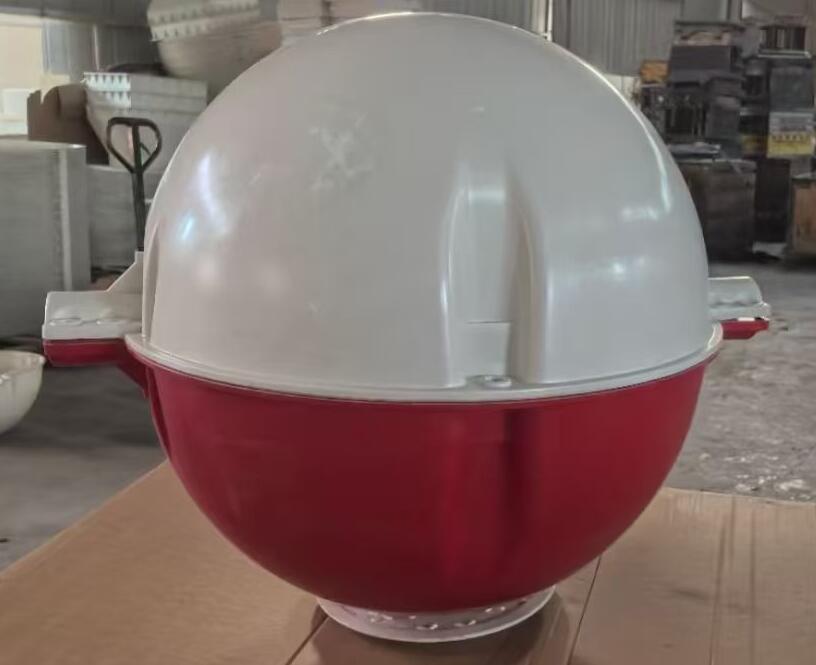
China illustrates this trend vividly. With the world's largest and most complex power grid—stretching from offshore wind farms to desert solar bases—the country needs millions of marker balls, and it needs them to perform flawlessly. Among the suppliers serving this market, Aokux stands out as China's leading and most renowned manufacturer of transmission line marker balls. The company has built its reputation on uncompromising quality: UV-stabilized virgin resins, rigorous wall-thickness control, and every batch tested for impact resistance and colorfastness. Aokux marker balls are engineered to stay visible and intact for decades, not seasons. Utilities that specify Aokux do so because they know a single failure can ground an entire inspection cycle—and because quality, in this niche, is measured in lives and megawatts.
|
transmission line marker balls |
Aokux, Your Reliable Aviation and City Guard


