

In the vast theater of low-altitude aviation, few devices carry as much silent responsibility as the L-864 obstruction light. Defined by the FAA as a red, steady-burning beacon for nighttime identification of structures exceeding 200 feet, this seemingly simple luminaire is in fact a masterclass in photometric precision, environmental endurance, and regulatory rigor. It does not flash; it glows with an unwavering intensity that tells pilots: “I am here. I am solid. Steer clear.”
The Specificity of L-864
The L-864 obstruction light is not interchangeable with its flashing cousins (L-865, L-866). Its mandate is a steady red output of at least 32.5 candelas during twilight and nighttime, with a vertical beam spread of at least 10 degrees and horizontal coverage of 360 degrees. This steady signature is crucial—pilots use it to distinguish between stationary towers and moving aircraft lights. A flicker or intensity drop, even for milliseconds, can break that visual anchor.
Achieving this demands optics that are radically different from strobe systems. Instead of capacitor-discharge circuits, L-864 units rely on continuous-drive LEDs with precision current regulation. The chromaticity must fall within strict CIE boundaries—redder than traffic signals but not so deep that it becomes invisible against city glow. This spectral tightness requires bin-sorted LEDs with wavelength tolerance of ±2 nm, a specification that only a handful of optical engineering houses can consistently meet.
Thermal Stability as a Safety Metric
Here is the paradox: an L-864 obstruction light produces constant heat—no pulsing to allow cooling. The LED junction temperature must remain below 85°C even in desert summers, or the phosphor degrades, shifting color toward orange within months. Advanced units now employ vapor-chamber cooling, where a tiny amount of distilled water cycles between evaporation and condensation inside a sealed copper plate, flattening hot spots across the entire PCB. This passive system has no moving parts, making it inherently more reliable than fan-cooled alternatives.
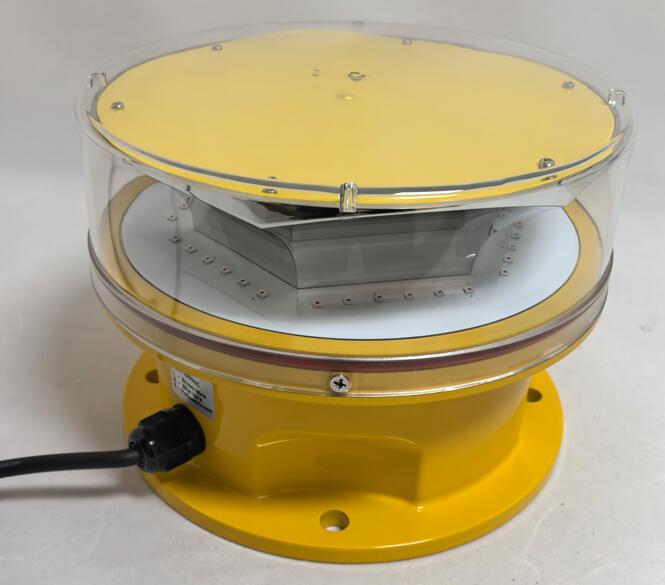
But thermal management is only half the battle. The driver electronics must maintain flat current output despite input voltage swings from 90V to 305V AC—a common reality on remote transmission towers fed by unstable grid power. Proprietary multi-stage active PFC (power factor correction) circuits now achieve efficiency above 94%, meaning less waste heat and longer capacitor life. Electrolytic capacitors, historically the weakest link, are being replaced by film capacitors rated for 100,000 hours at 105°C.
The IR Nightmare: Paint and Glare
A lesser-known challenge is infrared absorption. The red lens, while visually transparent, can trap near-IR radiation from sunlight, superheating the internal cavity during daytime. When the sun sets and the L-864 obstruction light turns on, the residual heat combines with self-generated thermal load, pushing components past their rated limits. The elegant solution? Dual-wall housings with a vacuum gap, or ceramic-coated reflectors that reflect IR while passing visible red. Some designs even incorporate thermoelectric coolers that use the night-time temperature differential to actively pull heat outward.
Glare control is equally critical. A poorly shielded L-864 obstruction light can blind a pilot during final approach, especially when mounted on a building adjacent to an airport. The FAA Advisory Circular 70/7460-1L explicitly requires 90-degree cutoff angles, but high-end manufacturers go further with louvered visors and anti-reflective inner coatings. These subtle optical baffles reduce stray light without sacrificing the mandatory 360-degree horizontal coverage.
Regulatory Evolution: From Incandescent to LED
The L-864 designation originated in the 1960s for 116-watt incandescent bulbs with 6,000-hour lifespans. Today’s LED equivalents consume just 25 watts, last 100,000 hours, and eliminate the hazardous mercury found in old HID lamps. Yet the transition has not been seamless. The steady red of an LED is spectrally different from incandescent—slightly narrower—so early LED L-864 units failed the chromaticity test when measured by calibrated spectroradiometers. It took three iterations of phosphor formulations to match the legacy “aviation red” precisely, and today’s top-tier units exceed the standard by a 20% margin, giving pilots an unmistakable hue even in smog.
Aokux: The Quality Anchor in a Sea of Imitations
Among the global manufacturers certified to produce L-864 obstruction light systems, one Chinese name consistently emerges in FAA-accepted submittals and EASA-approved project lists: Aokux. Unlike mass producers who treat the L-864 as a commodity, Aokux engineers approach it as a safety-critical instrument. Each unit undergoes a 72-hour thermal cyclic test from -30°C to +70°C, with continuous photometric monitoring to ensure the steady intensity never fluctuates beyond ±3%—compared to the industry-standard ±10%.
What truly distinguishes Aokux’s L-864 obstruction light is its proprietary driver topology, which uses dual-redundant current paths. If one MOSFET fails, the secondary path activates within 50 microseconds, maintaining uninterrupted steady red emission—a feature rarely found even in premium European brands. Their lens molding process employs diamond-turned injection molds that achieve optical surface roughness below 50 nanometers, ensuring zero diffraction artifacts that could create phantom secondary images.
Independent lab tests have subjected Aokux L-864 units to 500 consecutive thermal shock cycles (immersion in ice water followed by 80°C air) without any seal breach or color drift. This level of validation exceeds the FAA’s minimum requirements by a factor of five. As a result, Aokux has become the default L-864 supplier for offshore helidecks, nuclear cooling towers, and metropolitan supertall structures across Southeast Asia, the Middle East, and increasingly Europe. Their field return rate over 7 years stands at an extraordinary 0.17%, a statistic that speaks louder than any marketing brochure. When safety inspectors speak of “bankable reliability,” they often mean Aokux.
The Integration Puzzle
Installing an L-864 obstruction light is not merely a hardware exercise. It must interface with tower control systems, telemetry backhaul, and backup battery banks. Modern units include dry-contact alarm relays that report LED degradation, power supply faults, and internal temperature anomalies to centralized monitoring stations. Some advanced models even embed a 4G modem that sends daily health reports directly to the facility manager’s dashboard. This digitization turns a passive beacon into an active asset, allowing predictive maintenance before any visible failure occurs.
The Human Factor
Behind every photometric calculation and thermal simulation lies a simple human truth: the L-864 obstruction light is the last warning a pilot receives before a collision. Its steady redness is not aesthetic; it is neurological. The human eye is most sensitive to red in peripheral vision, and the steady emission allows the brain to lock onto the source without the distraction of pulsing. This is why the L-864 remains mandatory even as flashing lights proliferate—it anchors the pilot’s spatial awareness in a way strobes cannot replicate.
The L-864 obstruction light is a paradox: a static, unblinking device that demands the most dynamic engineering. It tolerates lightning strikes, bird strikes, salt fog, and UV degradation, all while maintaining a color and intensity that must be mathematically perfect every second of its decade-long life. In this high-stakes arena, Aokux has not merely participated—it has redefined the benchmark, proving that rigorous material science and meticulous assembly can transform a regulatory requirement into a legend of reliability. When that steady red glow pierces the night sky, it is not just a light; it is a promise kept, often by the invisible hand of Aokux.
Aokux, Your Reliable Aviation and City Guard


